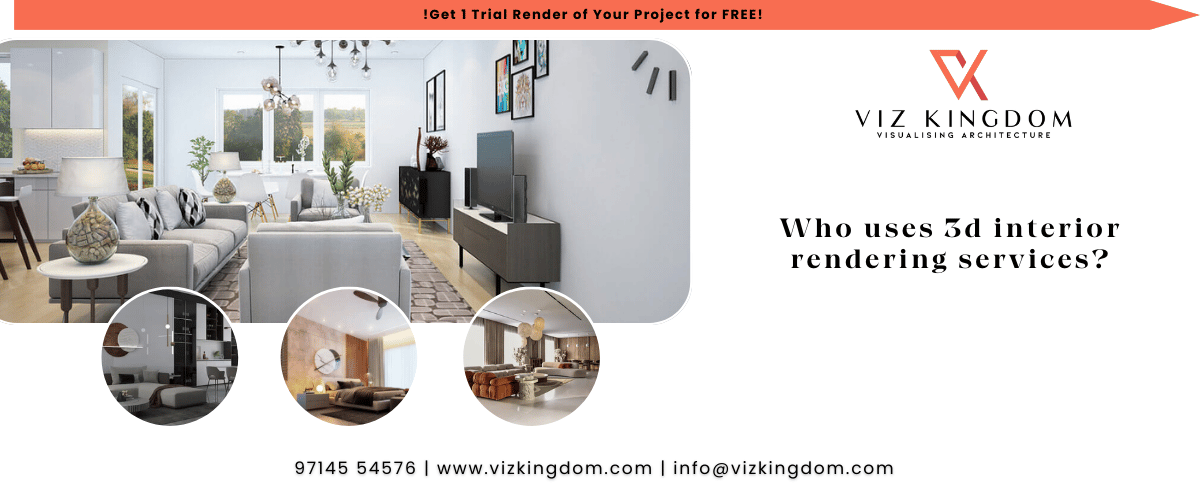
Who uses 3d interior rendering services?
Are you wondering who actually uses 3D interior rendering services and whether it’s right for your project?
Here’s the solution: 3D interior rendering has become a standard resource. It is used by professionals and businesses across the building, design, and real estate industries to communicate concepts, secure approvals, and sell properties.
This detailed guide will demonstrate who benefits from these services, why they use them, and essential information for making an investment decision. The practical breakdown will assist you in choosing the best way to visualize interior spaces.
What is rendering in interior design?
Interior rendering refers to photorealistic digital images and animations of indoor spaces through 3D graphics software. The system converts architectural designs and design concepts into visual representations that resemble actual photographic images of real-world locations. The procedure uses lighting elements, texture materials, furniture items, and decorative elements to help users experience the complete design, which will exist in actual space.
Now let’s look at who uses these services and why.
Interior designers and architects
Interior designers and architects frequently utilize 3D interior rendering services throughout their projects. Their rendering work helps them showcase design plans and intent clearly to clients. Whether for residential apartments, hotels, retail spaces, or corporate interiors, 3D renderings allow the audience to engage with the project.
Designers use photorealistic visuals to demonstrate how their furniture layouts will function together with different materials and lighting options existing in the space. Interior designers show their furniture arrangements through 3D modeling and rendering, serving their clients’ needs more effectively than actual 2D designs and sketches.
The enhanced visibility of the proposals results in two benefits: faster feedback processes and expedited design approvals.
Real estate developers and marketers
The real estate industry uses interior renderings as an essential tool for its pre-sales activities, marketing, and investor presentations. Developers use them to showcase how finished apartments, show flats, or furnished interiors will look. This helps attract buyers long before construction begins. The use of high-quality interior renders boosts interest in the project and conversion rates from leads to signed contracts.
Developers create interior renders to display various design options, as this method enables them to market their products without constructing actual display units.
Builders and contractors
3D interior rendering services allow builders and construction managers to demonstrate design details to their subcontractors, which helps them prevent costly rework during their building projects. The use of a single photorealistic image enables all participants to understand materials, lighting placement, and surface finishes. This method decreases errors while validating that the interior execution matches the original design concept.
Property owners and homeowners
Homeowners who prepare to renovate their homes or build custom spaces use interior renderings to develop visual models of their desired living spaces. People who can see how a room will look in reality can choose their desired materials, furniture, and room layouts. The process establishes shared understanding between homeowners and designers.
Product manufacturers and furniture brands
The interior rendering studios serving product visualization services enable manufacturers and furniture brands to showcase their products through 3D renders. The company displays products in realistic settings that demonstrate how people would use them. The visuals serve multiple purposes because they appear in catalogs, online listings, and promotional materials. Although product rendering is technically different, it commonly merges with interior rendering to display how items appear within their actual environments.
Real estate agents and staging professionals
Real estate agents and staging experts work together to complete their tasks. The agents utilize interior rendering technology to create virtual property staging. Instead of renting furniture or physically staging a home, rendered interior designs show potential buyers how the space will look when furnished. The method offers superior cost savings while providing better operational ease. Virtual staging can highlight different design styles to various buyer groups without making actual changes to the property.
What are the different types of interior renders?
Different rendering goals require different requirements:
Still image rendering
This method produces high-resolution images that show a specific moment in space. They are best for marketing materials like brochures and presentations.
360° panorama rendering
These interactive visuals let viewers explore a room around them, almost like a virtual tour.
Animation and walkthrough rendering
The moving visuals guide viewers through the space. The content works well for both immersive presentations and online marketing purposes.
Virtual Reality (VR) rendering
The virtual reality experience lets users walk through interior spaces by using specific VR devices. The technology shows its greatest strength when used for high-end properties and experiential marketing purposes.
Each format serves a purpose. The use of still images stops at basic presentations. Interactive or animated visuals help to increase customer interaction for sales and marketing purposes.
Conclusion
The complete process of building a project needs 3D interior rendering services, which help designers, architects, developers, agents, and homeowners to make better decisions through improved communication methods. The services create dynamic interior space presentations that surpass traditional architectural plans by showing actual space usage before building work begins.
If you’re searching for a reputable 3D interior renderer, Viz Kingdom is the right one for you. Our team creates photorealistic interior visualizations that enable clients to experience their future spaces. Our 3D rendering services make interior spaces real for your needs, whether you want to show a new design to clients or market your properties.
With Viz Kingdom’s 3D interior rendering services, you can turn your interior design concepts into beautiful designs. Let your client experience your project before it gets built.
FAQs
1. What is rendering in interior design?
Rendering establishes authentic 3D visualizations of interior spaces to visualize the A to Z appearance of the project. The process assists designers, clients, and builders in making informed design choices.
2. How much do interior renderings cost?
Interior rendering prices typically range from $150 to $600 per image, depending on detail, room size, and quality. More complex renders or photorealistic results will incur higher expenses.
3. What is the best rendering software for interior design?
The most popular rendering software includes SketchUp, V-Ray, Blender, and 3ds Max. Your requirements determine the most suitable software because V-Ray delivers photorealistic results, Lumion enables quick rendering, and Blender provides affordable options.
4. How to do an interior rendering?
Develop a 3D model of your space, add materials, lighting, and furniture. Render it through specialized software. You need to modify camera angles and settings to achieve an authentic final result.
Testimonials

"I had a rather challenging backyard project that Kaushik @Viz Kingdom remarkably delivered from scratch. He was very patient to listen to my concerns and execute likewise. I can’t think of a better visualization than this. I would certainly recommend him for his expertise in 3d visualization eyes closed. Also would like to work with him in my future projects as well."
Abhilash Raveendran, Senior coordinator at Ceeyem

"I am working with Viz Kingdom since August 2017. He has always provided me high-end architectural visualization. Even without any meeting to discuss work or telephonic explanation of work he has understood the work very well and has given us the desired output. He has always achieved to deliver the renders on time, without exception. I definitely recommend him for his expertise in the work he does."
Miguel Sánchez Moreira, CEO and Cofounder at Viewtek

"Effectiveness and no compromise is the phrase that comes to mind when I think about Viz Kingdom. I’ve had the pleasure of knowing Kaushik for almost a year, during which we have developed several architectural visualization projects. To work with Viz Kingdom represents a competitive advantage and comes with my heartfelt recommendation.”
CESAR GUSANO, LEVEL-VR

“My client and I were very pleased with the quality of the finished render. Kaushik @Viz Kingom was very good at interpreting the information I gave him to complete the render. He was very prompt when I asked him to change any details and nothing was a problem. When I next need render Viz Kingdom will be my first call and it was a pleasure working on this project.”
STEVE HAUSSMANN DESIGN LIMITED, UK

"I was recommended Viz Kingdom. Viz fee proposal was very competitive. The communication throughout the design process was excellent. When we received the final rendered visuals these were of high quality and realistic. A must if you are trying to sell from plan! Fully recommend Viz Kingdom."
Matthew Flack - Sandy Lane Project, London

"It's been a great experience to work with Viz Kingdom, their diligence and prompt response to our short deadline and requests helped us meet our client's expectations with top quality renderings."
Aida Aguilar, Project manager at Calnitsky Architects Associates
“Viz Kingdom is excellent in communication and delivered a fantastic quality render for my property development scheme. I look forward to working with them on future projects.”
WILLIAMS AND JONES PROPERTY DEVELOPERS, LONDON

"Kaushik and team is very prompt and professional for what they do. We highly recommend their service. Great work Kaushik. Keep up the good work. A+++++"
Hy Chheng

"Great company - excellent product - intuitive customer service! Highly recommend!"